

Along the ghats of Varanasi, the rhythmic clatter of the handloom has echoed for centuries. Banarasi weaving is one of India's oldest textile traditions, believed to have flourished under Mughal patronage, when Persian motifs first began weaving their way into Indian silk.
The craft behind the cloth
A single Banarasi saree can take anywhere from a few weeks to several months to complete, depending on the intricacy of its zari work. Weavers work from a naqsha, a hand-drawn graph that maps out every motif thread by thread, long before a single pick is woven into the loom.
Motifs with meaning
The characteristic buta (paisley) and jhallar (fringe-like border) patterns are more than decoration. Many motifs trace back to Mughal-era gardens and architecture, a quiet record of the cultural exchange that shaped the craft.
A tradition carried by hand
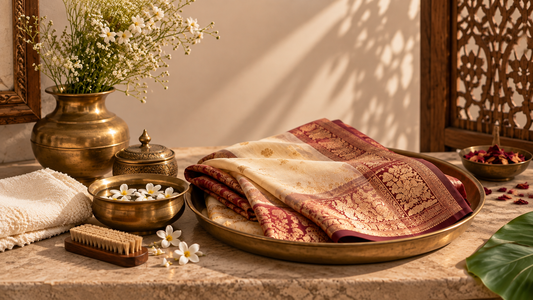
Today, most Banarasi weaving is still done on traditional pit looms, passed down within families across generations. Each saree that comes off the loom carries the fingerprints of the artisan who made it — no two are ever quite identical.
When you wear a Banarasi saree, you're not just wearing silk and zari. You're carrying forward a centuries-old conversation between craft, culture and the hands that never let it fade.
Tags:
Related articles
-
Sep 20 2026
A Guide to Caring for Handloom Sarees

-
Sep 20 2026